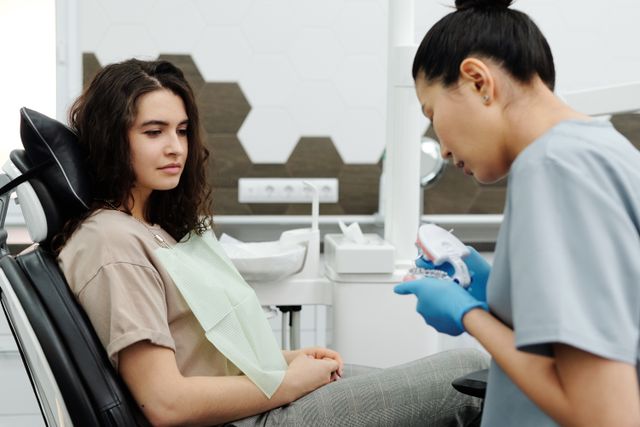
Deciding on a new dentist is not something to take lightly. You’re making a long-term investment in your health, and potential future expenses, and you’re trusting them to care for your family’s teeth and gums. It’s important to choose a dentist you trust and who you can build a good relationship with. To help make your decision easier, we’ve rounded up the best tips for choosing the perfect dentist for you.
Start by defining what your family actually needs
Identify what YOU need in a dentist, then go hunting. Family-friendly means different things to different people. For some, it’s about a gentle touch with little ones, toys in the waiting room, and the ability to see multiple patients in one block. For others, it’s completely-closed treatment rooms because multiple sounds and smells send an autistic child into crisis. Prospective dad in the middle of a root canal with undiagnosed PTSD may need a dentist who works in conjunction with a mental health professional to manage panic attacks in the chair.
Settle the NHS versus private question early
This decision point determines a lot, so take the time to think it through before researching individuals.
NHS work is all about what’s clinically necessary – fillings, extractions, root canal work, check-ups – and most of it’s priced in bands. Not covered: cosmetic work (whitening, some crowns and bridges), and availability varies by area and practice. Some areas have long waiting times, and more practices have stopped taking on new NHS patients than are opening waiting lists.
Private will usually cost more (it won’t always be significantly more expensive if money is your concern). In return, you’ll wait less time for an appointment, earn more flexibility around timing, materials, and after-care, and be offered other options not available on the NHS.
Check credentials before you check reviews
This is the most easily skippable step of the lot, and strangely it’s the one that’s actually in your self-interest. Every dentist working in the UK must be on the register of the General Dental Council, and that register is public. It’ll take you two minutes to look up a dentist’s name, check that they’re properly qualified and holding up their end of the bargain. If a practice website lists the dentists who work there, do that bit of homework too.
Then read the CQC report for the practice. The CQC inspects dental practices and publishes reports online which cover whether they are safe, well-led, and whether care is effective and responsive. A report from the last six months with no red flags is a better signal than a five-star Google rating, because an inspection makes an evaluation across actual criteria, rather than a self-selected sample of pleased or annoyed patients. It’s boring, unglamorous groundwork. It’s also the only filter you have before you’ve crossed a threshold.
Shortlist by logistics, not just reputation
For the list of acceptable practices you have after round one and two of the selection process, look at the services they offer. If you have kids, you are likely to need pediatric dentistry too. You may also end up needing an orthodontist – ask whether the practice offers that service. The closely related question of whether the same practice also offers cosmetic dentistry won’t seem relevant if you’re looking for a family dentist, but it’s worth keeping in mind. You may never foresee that wanting a brighter smile, a dental implant, or a chip fixed will turn into a “need,” but it might.
Then again, looking for a dental practice should be about looking long-term. A practice like a Rowley Regis dentist, for example, works well as a shortlisting benchmark because the more services under one roof a practice offers that you might conceivably need later on, and provided by a practitioner who already knows your dental and medical history when you walk in the door, the better the long-term convenience. Make that decision worth more than ten minutes of driving in heavy traffic.
Look at the range of services under one roof
A practice that only does routine check-ups and fillings will end up referring you elsewhere the moment anything more complex comes up – orthodontics for a teenager, root canal treatment, cosmetic work, or specialist care for a nervous child. Referrals aren’t necessarily bad, but they add time, paperwork, and a new set of unfamiliar faces at a moment when you’d rather things were simple.
Look for practices offering children’s dentistry with a genuinely child-friendly approach, hygienist-led preventive care, orthodontics, and dedicated emergency appointment slots. A practice that covers this range means your seven-year-old, your anxious partner, and your parent needing a crown can all be seen by people who already know your family’s history. That continuity is worth more than it sounds – dentists who’ve treated someone for years notice small changes that a stranger wouldn’t catch.
Emergency access deserves particular attention if you’ve got young kids. A knocked-out tooth or a bad toothache over a weekend needs somewhere to go that isn’t an A&E waiting room. Ask directly what happens outside normal hours before you need to find out the hard way.
Ask how they handle dental anxiety
This is where a lot of practices reveal themselves, one way or another.
Dental anxiety is far more common than most people assume. Around 12% of UK adults report extreme dental anxiety or phobia, and roughly one in three feels some degree of unease about visiting the dentist at all (source: Oral Health Foundation). If that describes anyone in your household, the way a practice talks about anxious patients tells you almost everything you need to know.
Ask specific questions. Do they offer breaks during longer procedures? Is sedation available, and for whom? How do they introduce nervous children to the surgery before diving into treatment – do they let kids sit in the chair without anything happening first, just to get comfortable? A practice with a genuine, thought-through answer to these questions has clearly dealt with anxious patients before and built a process around it. A practice that shrugs or gives a vague “we’re very gentle” response probably hasn’t thought about it much at all. That’s a real signal, not a minor detail.
For families with children, this matters doubly. A bad first dental experience at age five can shape how someone feels about dentists for the rest of their life. Practices that take this seriously are worth the extra ten minutes of asking around.
Read reviews for patterns, not single incidents
Feedback from other patients can be helpful, but it’s important to review it with a critical eye. A single one-star review regarding a payment problem will not give you a bigger picture – there will always be a dissatisfied patient. Instead, analyze the common feedback from several reviews on Google and NHS Choices.
If multiple reviewers point out the same problem – lengthy waiting times, feeling rushed during appointments, or constantly being sold additional products or services – this should be a red flag. When it’s just one one-off negative comment, it’s less likely to be the reality.
Pay attention to how the business addresses the complaints. If they respond professionally and try to solve the issue they are probably good at handling various situations. If they ignore comments or are outright hostile, this is a bad sign. Check for a common response that they copy and paste to every complaint.
Get costs and payment options in writing
Before you commit to any treatment outside of those covered by standard check-ups, ask for a written treatment plan and an itemized estimate. This should outline exactly what is going to be done, what it’s meant to achieve, and how much it will cost. This ensures there’s no confusion later on about what was agreed to or why.
It’s also worth checking whether the practice offers any kind of financing. Many offices have membership or payment plans, similar to those offered by Denplan, that allow you to spread the cost of check-up and maintenance work across the year instead of paying each time. This sort of payment could make a big difference if you’re booking in more than one person for regular check-ups. If the dentist is clear about what they charge and offers convenient ways to pay, it’s a good sign you’re not going to get any nasty shocks later.
Treat the first appointment as a trial run
Everything up to this point is groundwork. The first actual visit is where you find out if the groundwork was correct.
Look for the basics: is the reception welcoming, or rushed and indifferent? Are you seen close to your appointment time? Does the surgery look clean, with visible infection-control practices – gloves changed, surfaces wiped, instruments properly sterilised? Modern equipment like digital x-rays and intraoral cameras isn’t essential, but it’s a decent indicator of a practice that invests in itself rather than coasting on old kit.
Most importantly, listen to how the dentist talks to you. Do they explain what they’re finding in plain language, or bury it in jargon you’re expected to just nod along to? Do they recommend treatment because it’s actually needed, or does everything somehow need doing today? A dentist who explains, who isn’t rushing, and who doesn’t pressure you into treatment on the spot has passed the test that actually matters.
That first visit is the strongest predictor you’ll get of what the next several years with this practice will feel like. Trust it.