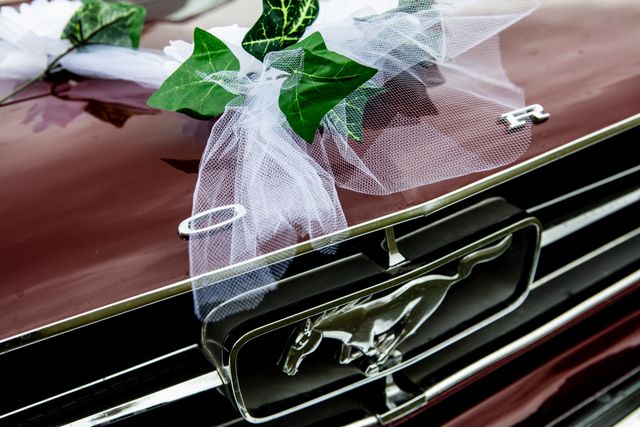
Many couples choose their wedding car in the same manner as they would select a tie or a pair of shoes – they think it looks nice, so they go for it. This is the wrong approach. The car should not be treated as an afterthought to the day, but rather, as a component of the overall design, and should complement the location in the same way that flowers complement the table setting.
Why The Car Is Part Of Your Venue’s Story, Not Separate From It
Consider how frequently the car appears in your wedding photos. There’s a shot when you arrive, the building in the background. A group photograph as your uncle leans against the hood. And then the exit – the whole shebang. The vehicle’s on-screen time adds up but is typically given about 15 minutes of design consideration by most couples.
A 1960s Rolls-Royce outside a glass-walled hotel looks like it got lost on the way to a sci-fi set. As does a black Mercedes S-Class on the gravel of a 400-year-old manor. Neither car nor venue is ‘wrong’. They’re just incongruous when lumped together, and once you see that in photos, you can’t unsee it.
Reading Your Venue’s Architecture First
First things first: Before you even get seduced by a single car brochure, take a deep look at your venue. And we don’t mean the brochure shots – we mean the real, physical space.
Country homes and manor houses are a natural fit with the classic marques. A Rolls-Royce Corniche or a Bentley S-Type sitting in a sweeping gravel drive in front of stone pillars doesn’t require you to do much more than open a car door. These places were born in an era when cars like this existed, so the pairing reads as continuity rather than costume.
Rustic barns and countryside venues – still the most popular category of wedding venue – work brilliantly with vintage cars too, but for the exact opposite reason. It’s because contrast is what you’re after, not seamless visual continuity. A pale, elegant classic pressed against timber beams and weathered stone creates the kind of visual tension that photographs well. A small vintage car parked beside a hobnail oak door is already a charmer because it’s unassuming and does not in any way try to compete with its surroundings.
Modern hotels and airy lofts demand wholly another logic. Glass, steel, and minimalist interiors do not go hand in hand with chrome grilles and running boards. Something current – like an executive model Mercedes S-Class or even a Tesla Model S for the most contemporary kind of couple – is the way to go. Sharp architecture wants sharp, clean vehicle design alongside it. The swooping lines of a recent model just fit better against all that glass.
Colour Is Doing More Work Than You Think
Once you’ve nailed the era, colour is your mood board in a pot. This is where loads of couples throw their hands up and say, ‘Oh, whatever, it’s just a car’ but actually, your paintwork needs to play nicely with three other things: the venue outside, the bridesmaids’ dresses, and the flowers in season.
Ivory and white classics complement light stone facades and bunting-strewn barns beautifully. They reflect those warm-glow vibes of a summer’s evening and don’t clash with sugared-almond pastels. Deep black or gunmetal grey, conversely, goes well with venues of the more dramatic persuasion – either because they have flat-out dark interiors or because they’re bold modern statement exterior kind of things (slate roofs, black windows). It will hold its own in the photography stakes against all that glass and steel – a white car against that can often look a bit washed out and bridal-cliché by comparison.
If your colour palette is more of the jewel-toned variety (so, deep reds, foresty greens, navy etc), a classic car in a deep complementary colour will fill your photographer’s heart with exponentially more joy than a generic white hire car ever could. Tiny choice, outsized payoff.
Treating The Car As A Photography Prop, Not Just transport
Many photographers will say the car is one of the easiest things to under-use. Clients book it, get in it, and then forget that it’s also a prop which can anchor a whole set of images.
Discuss with your photographer in advance of the day where the car will be parked and when. If your venue has a pillared entrance, an orchard, or just a particularly good stretch of driveway, schedule a few minutes with the vehicle down at that spot. A five-minute detour for some photos with the car against the right backdrop is worth more than an extra hour of generic couple portraits if there’s nowhere else on location the car ‘wants’ to be snapped with you both.
This is also where the car being right for the venue is worth the money you spent on it. A car that already fits the location gives your photographer a compelling element they can build a composition around, rather than one that they either have to crop down or work through.
The Logistics Nobody Thinks About Until It’s Too Late
This is the guide part that most people skip over. And it’s the part that actually causes issues on the day.
Low-slung classics don’t deal well with gravel driveways, grass verges, or steep, narrow access roads. Some of the dreamiest manor house venues have drives that wouldn’t comfortably accommodate a small hatchback, let alone a car built sixty years ago with different suspension and a wider turning arc.
Modern long-wheelbase cars have the opposite issue sometimes: they need more room to manoeuvre and reverse than an older, more compact classic. A tight courtyard entrance that a small vintage car glides round might actually be impossible for a long modern saloon.
Before you book anything, just check:
- Driveway width and surface (gravel, grass, tarmac)
- Turning space at the entrance and exit points
- Whether the venue has a specific drop-off area separate from guest parking
Your venue coordinator or wedding planner will usually know this stuff already, as they’ve watched other suppliers navigate the same driveway a dozen times. Just loop them in and get them to send their suggestions direct to your chauffeur ahead of the day, rather than phoning through at 9 am on the morning of your wedding with panicked instructions.
Who’s Actually Getting In The Car
It is simple to organize transport around the couple and overlook everyone else. Bridesmaids wearing full-length dresses, mothers wearing firmly tailored dresses and hats, flower girls who should be assisted into the vehicle – this all influences the practicality of the vehicle, not just the aesthetic appeal.
Two-door vintage cars are magnificent but are really inappropriate when you have to shuffle a bridal party of four or five in and out a few times without getting dresses caught and hairstyles destroyed. If your bridal party is big, you will likely need a following vehicle anyway. Or a different type of vehicle with far better entry for everyone except the bride.
Consider the entire morning, not just the ten arrival minutes: pickup from the bride’s home, the drive itself, arrival, and the quick photo opportunity before the service begins. Each of these has unique entry and comfort needs.
Applying This Across Different Regions
The framework holds regardless of where you’re getting married, but local knowledge still matters a lot. A county like Essex has a genuinely wide mix of venues – countryside barns out toward the Suffolk border, grand hotel ballrooms nearer the towns, and a fair number of period manor houses in between. The right car for one is rarely the right car for another, and a supplier who’s actually driven those specific driveways before is worth more than one working from a photo online.
This is where booking locally pays off. A team offering Wedding Cars Essex has likely already worked the gravel at your manor house or the tight turning circle at your barn venue, and can tell you before the day whether your first-choice car will actually manage the access without drama.
Building In A Weather Plan
Let’s face it, the UK weather is highly unpredictable. As much as you may dream of arriving in an open-top vintage car, the reality is that you may need to consider opting for something with a roof. Fixed-roof classic cars are therefore a more reliable choice. Modern cars are climate-controlled, making them the most weather-appropriate option. This is particularly important for a winter wedding or if your venue requires a lengthy outdoor walk from where the car can park to the entrance.
Whatever you book, ask your supplier directly what the wet-weather plan looks like. A good provider will already have one – an umbrella escort, a covered drop-off point, a backup roof arrangement – rather than leaving you to figure it out if it starts raining twenty minutes before your ceremony.
What This Actually Costs You
Based on Hitched’s National Wedding Survey, an average UK wedding costs more than £20,000, while generally, transportation costs are minimal. This makes the car one of the most effective visual investments of the entire day. It’s not a case of a good car or a cheap one – it’s a case of a car that looks like it’s a random last-minute booking and a car that looks like it was always part of the dream, often at no extra cost.
Book Early, Especially For The Popular Dates
Good venues get booked over a year ahead. What a lot of couples don’t realise is that reputable car suppliers with limited classic fleets fill up on the same timeline, particularly for peak summer Saturdays. If you’ve fallen for a specific Rolls-Royce or Bentley model, don’t leave the booking until three months out – by then, the good ones are already gone for your date.
The Short Version
Start with the building, not the brochure. Let your venue’s architecture and colours point you toward an era and a shade, check the driveway before you fall in love with a specific car, and plan for weather and bridal-party logistics before you sign anything. Get that sequence right and the car stops being a rental you tolerate for an hour, and becomes one of the better-looking decisions in your wedding photos.